Jahaz Mahal (Ship Palace) at Mandu surrounded by monsoon greenery under a dramatic sky
Madhya Pradesh · Heritage & Romance

Mandu

The City of Joy — one of India's largest and most atmospheric fort cities, perched on the Vindhya hills with the legend of Baz Bahadur and Rani Roopmati echoing through centuries of magnificent ruins.

DistrictDhar, Madhya Pradesh
Best TimeOct–Mar & Monsoon (Jul–Sep)
Suggested Stay1–2 nights
From Indore~98–100 km · ~2 hrs
Ideal ForCouples, History Lovers, Photographers
About Mandu

one of India's largest and most atmospheric fort cities — and Its Greatest Love Story

Mandu, or Mandavgad, is a ruined fort city on a plateau in the Vindhya hills of western Madhya Pradesh. Dating from the 6th century CE and reaching its peak under the Malwa Sultanate in the 15th and 16th centuries, it is one of India's most extensive and evocative historic sites.

The fort complex — covering approximately 45 square kilometres — is the largest fort city in India and contains some of the most remarkable examples of medieval Afghan and Malwa architecture, including the ship-like Jahaz Mahal and the delicate Rani Roopmati Pavilion.

But Mandu's greatest draw is its legend: the romance of Sultan Baz Bahadur, the last independent ruler of Malwa, and Rani Roopmati — a Hindu singer and poet who agreed to the Sultan's hand only on condition that she could see the sacred Narmada River daily from her palace. The story of their love and its tragic end echoes through every arch and ruin of the city.

Among experienced travellers, Mandu during the monsoon season is considered one of India's most magical experiences — the ancient ruins emerging from a sea of green under dramatic skies.
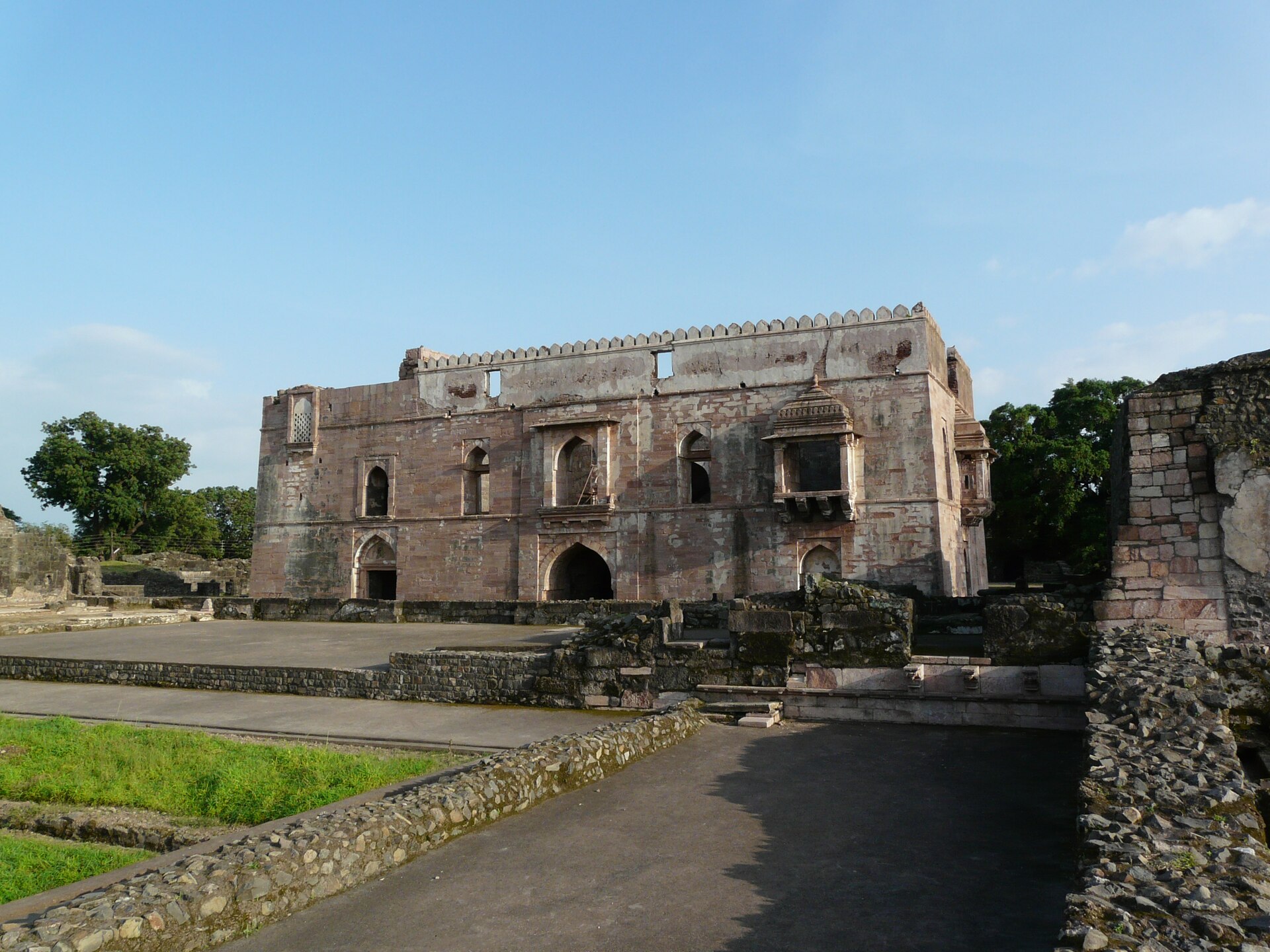
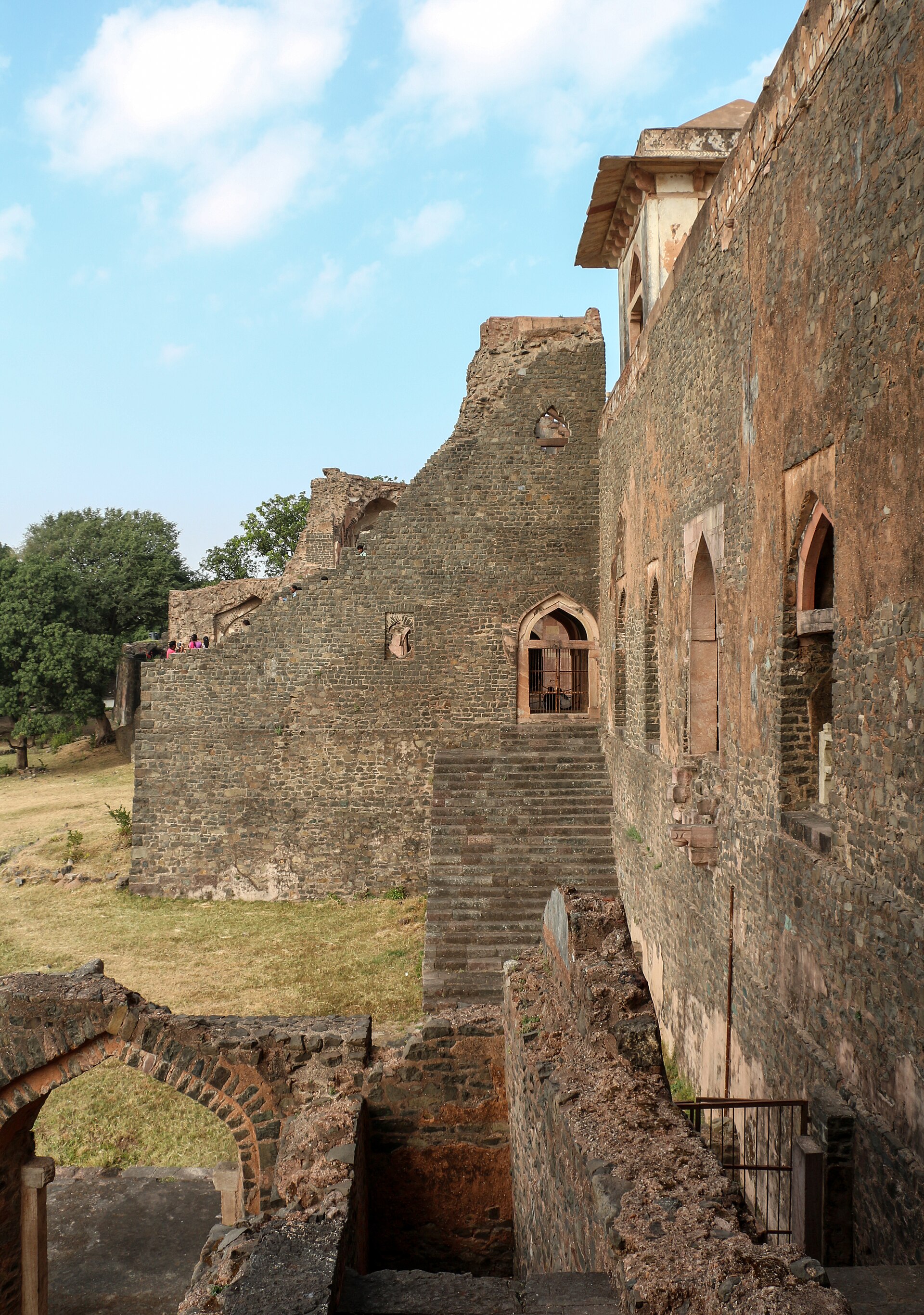
The Hindola Mahal (Swinging Palace) in Mandu with its dramatically inclined walls
Key Attractions

Places to Visit in Mandu

Hindola Mahal (Swinging Palace)

A royal audience hall built around 1425 CE, famous for its massive walls inclined at 77 degrees — creating a striking optical illusion of swaying motion (hence the name). One of the most photographed and architecturally unusual structures in central India. The Light and Sound show here narrates Mandu's history and the Baz Bahadur–Roopmati legend.

Hoshang Shah's Tomb

India's first marble tomb, completed around 1440 CE for Sultan Hoshang Shah of the Ghuri dynasty. Its elegant white marble dome and refined proportions were later studied by the architects commissioned by Emperor Shah Jahan — it is considered a direct architectural precursor to the Taj Mahal. One of the most understated and beautiful monuments in Madhya Pradesh.

Jami Masjid

A grand Afghan-style congregational mosque inspired by the Great Mosque of Damascus, with a vast courtyard flanked by domed galleries on three sides. Begun by Hoshang Shah and completed by his successors, it remains one of the most complete and magnificent medieval mosques in central India.

Baz Bahadur's Palace

The palace of the last independent Sultan of Malwa — a spacious complex of elegant arched corridors, large courtyards and pavilions. Adjacent to the Rewa Kund, a reservoir that still supplies water through a gravity-fed system designed centuries ago. The palace carries the melancholy of Mandu's final chapter as a royal city.

Champa Baoli

A unique stepwell-mosque complex with cool underground chambers that provided relief from the intense Malwa summer. The stepwell descends several levels into the earth, with arched chambers at each level — a masterpiece of vernacular engineering and an atmospheric photographic subject.

Ashrafi Mahal

A former theological college (madrasa) converted by Sultan Mahmud Khilji into a victory tower commemorating his military campaigns. Now a striking ruin, the partially collapsed tower and surrounding arches create one of Mandu's most evocative heritage photographs.

Mandu in Monsoon

July to September

A Seasonal Secret

Why Monsoon is Mandu's Most Magical Season

Unlike most heritage destinations, Mandu is particularly beloved by experienced travellers during the monsoon. When the rains arrive in July, the plateau transforms into a landscape of extraordinary lushness — waterfalls cascade down the fort walls, the artificial lakes fill to surround the Jahaz Mahal, and the entire plateau turns a vivid green against dramatic monsoon skies.

The ruins gain a romantic, ethereal quality in the mist and rain. The Jahaz Mahal truly resembles a ship sailing on water. The views from Rani Roopmati Pavilion across the monsoon valley are unforgettable.

Mandu in monsoon is a niche travel experience that is gaining popularity among photographers, couples and heritage enthusiasts who want something beyond the conventional tourist trail.

Travel Information

Planning Your Mandu Visit

Best Time to Visit

  • Oct – Mar: Ideal weather; all monuments accessible comfortably.
  • Jul – Sep: Monsoon — the most atmospheric time; some roads may be affected but the experience is extraordinary.
  • Apr – Jun: Very hot; not recommended for an enjoyable outdoor visit.

How to Reach Mandu

  • ✈ By AirDevi Ahilya Bai Holkar Airport, Indore (IDR) — approximately 98–100 km. Private taxi: approximately 2 hours.
  • By RoadIndore to Mandu via state highway — well-surfaced road. Also accessible from Dhar (~35 km). State buses and private taxis available.
  • By RailNo direct rail access to Mandu. Nearest station: Indore Junction. From Indore, taxi to Mandu is the standard approach.

Visitor Tips

  • Allow a full day for Mandu — the monuments are spread across the plateau; rushing is not recommended
  • Hire a local guide or use an audio guide for historical context at Jahaz Mahal and Hindola Mahal
  • Rani Roopmati Pavilion is a must at sunrise or sunset — the light on the valley is extraordinary
  • The Light and Sound show at Hindola Mahal runs on select evenings — check locally for current schedule
  • Comfortable walking shoes are essential — monuments are spread across a large area
FAQ

Mandu Travel — Common Questions

  • What is the story of Baz Bahadur and Rani Roopmati?

    Baz Bahadur was the last independent Sultan of Malwa (reigned approximately 1555–1562 CE), celebrated as a musician and poet. Rani Roopmati was a Hindu singer and poet of exceptional talent whom he fell in love with. The legend holds that Roopmati agreed to live with Baz Bahadur at Mandu only on condition that she could see the sacred Narmada River every day — which is why her pavilion was built on the highest point of the fort, from which the Narmada is visible in the distance. When Akbar's general Adham Khan invaded and defeated Baz Bahadur, Roopmati is said to have taken her own life rather than surrender. Their love story is one of the most celebrated romantic legends in Indian history and inspired numerous poems, songs and films.

  • Is Mandu worth visiting in monsoon?

    Many experienced travellers consider the monsoon (July to September) to be Mandu's most spectacular season. The Vindhya plateau turns intensely green, the two lakes surrounding Jahaz Mahal fill with water, and the fort walls have waterfalls cascading from them. The atmosphere of the ruins in mist and rain is remarkably evocative. Some road access may be affected by heavy rain, but the experience — particularly Rani Roopmati Pavilion at dawn after rain — is considered one of central India's finest travel moments. We arrange monsoon Mandu trips with appropriate vehicle selection for the conditions.

  • How far is Mandu from Indore?

    Mandu is approximately 98–100 km from Indore by road, and the journey takes approximately 2 hours by private taxi or cab. Regular buses also ply the Indore–Dhar–Mandu route. Mandu can be visited as a day trip from Indore, but an overnight stay is recommended to experience the early morning light at Rani Roopmati Pavilion and to visit the full monument circuit without rushing.

  • Can Mandu be combined with Omkareshwar and Ujjain?

    Yes — Mandu, Omkareshwar and Ujjain can be combined in a 3 to 4 night trip, typically routed as Indore → Mandu → Omkareshwar → Ujjain → Indore. This gives travellers a mix of heritage and pilgrimage in a single journey. We arrange multi-destination MP itineraries — contact us with your dates and group size for a personalised plan.

Plan Your Mandu Heritage Trip

Day trips or overnight stays — we arrange comfortable Mandu visits from Indore, with or without combination destinations.